
Senior Door Refinishing Specialist · California Door Refinishing
⏱ 11 min read · Published August 2026 · Serving Los Angeles & Greater SoCal
If you live behind a gate or under a homeowners association in Los Angeles, refinishing your front door is rarely as simple as picking a stain and calling a contractor. Somewhere in a binder or a resident portal sits a set of architectural guidelines that may govern your door’s color, sheen, and even its hardware — and getting that step wrong can mean a rejected application, a violation letter, or a demand to redo the work in a different finish. HOA door refinishing in Los Angeles requires a different playbook than a standalone home: one that treats the association’s approval process as part of the job, not an afterthought.
This guide walks through how LA-area HOAs actually regulate door changes, what separates a refinish that sails through review from one that gets flagged, and how our team documents every project so residents in Bel Air, Brentwood, Pacific Palisades, and other association-governed communities across the city can refinish with confidence instead of guesswork. It’s also worth saying plainly what this guide is not: it isn’t legal advice, and it isn’t a substitute for reading your own community’s governing documents. What it does offer is a realistic picture of how the process tends to run across LA’s HOA landscape, drawn from projects our team has documented for association review, so you know what to expect and what to ask for before the work starts.
Request Your Free On-Site Quote Today
Why LA HOAs Regulate Door Refinishing in the First Place
Most Los Angeles homeowners associations exist to protect a consistent street-facing appearance across the community, and a front door sits squarely in that scope. Under California’s governing framework for common interest developments, an HOA’s authority to review exterior changes has to come from somewhere specific — either the community’s CC&Rs directly, or an operating rule the board adopted the proper way. That authority isn’t unlimited, either: the standard the board applies has to be written down and objective, not a vague appeal to “neighborhood character,” and the review itself has to move through the association’s process within a reasonable timeframe once a complete application is submitted.
In practice, this means two things for a refinishing project. First, if your HOA’s documents list exterior paint, stain, or door changes among the items requiring approval, you’re expected to submit before work begins, not after. Second, the association can only enforce standards that actually exist in its own paperwork — so a well-documented refinishing company that references your community’s approved palette by name tends to move through review far faster than a homeowner submitting a vague color description on their own.
It also helps to understand who’s actually reviewing the application. In most LA associations, this is either a dedicated architectural review committee (sometimes called an ARC), an architectural control committee (ACC), or in smaller associations, the board itself acting in that capacity. These committees are typically made up of fellow residents serving in a volunteer capacity, working from whatever design guidelines the board has adopted — which means the clarity of what you submit matters just as much as the finish itself. A packet that answers every question the guidelines ask, in the format the committee expects, tends to move through far faster than one that leaves the committee guessing or requesting more information.
How Weather and HOA Rules Intersect Across LA’s Microclimates
Los Angeles isn’t one climate zone, and that matters for HOA-governed doors in a way that goes beyond aesthetics. Coastal associations in Pacific Palisades or Malibu often specify marine-grade or UV-stable finish requirements alongside color rules, since a stain that isn’t built for salt air and fog will fail and need to be redone within a season or two — triggering the whole approval process a second time. Inland and hillside communities, by contrast, tend to focus their guidelines more heavily on color and sheen than on product durability, since the primary threat there is UV fading and heat-driven expansion rather than moisture. Knowing which threat your community’s guidelines are actually written around helps explain why the “right” answer for a Brentwood door and a Palisades door, even in the same approved color family, can call for a different finishing system underneath.
Door Refinishing West Hollywood
Refinishing vs. Replacing: Which Keeps You Out of Committee Purgatory
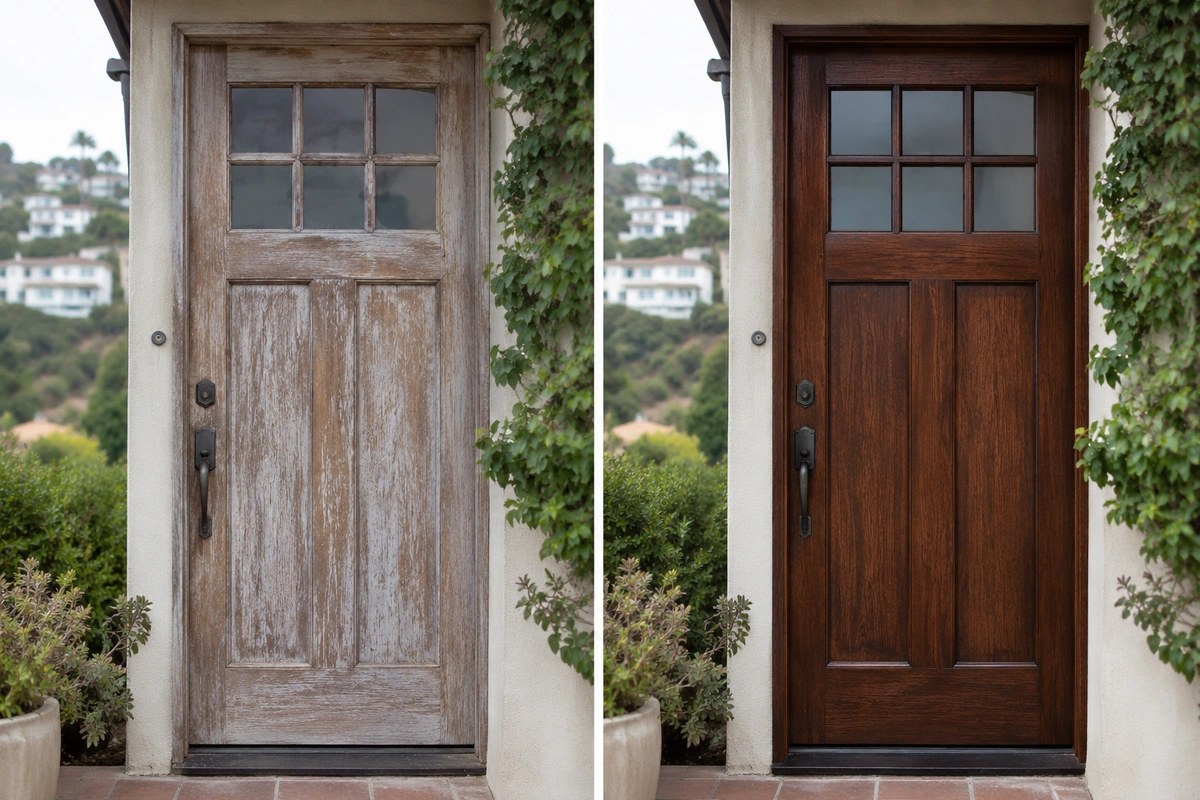
Not every door project triggers the same level of scrutiny, and this is where refinishing has a real structural advantage over replacement. A like-for-like refinish — same door, same approved color, same sheen — is often treated by architectural review committees as routine maintenance rather than a modification, especially when the community already has that color on file from a prior approval. A full door replacement, a color change, or a switch in material (say, swapping a painted door for a natural wood stain) almost always requires a fresh submission with samples, and sometimes a longer review window.
Door Refinishing Downtown Los Angeles (DTLA)
| Project Type | Typical HOA Review Trigger | Documentation Usually Required | Approval Friction |
|---|---|---|---|
| Refinish, same approved color | Often exempt or fast-tracked as maintenance | Confirmation of matching existing approved finish | Low |
| Refinish, new stain color | Standard architectural review | Manufacturer color code, physical sample, photos of door location | Moderate |
| Full door replacement, same style | Standard to elevated review | Product spec sheet, color sample, sometimes a site visit | Moderate to high |
| Replacement with material or style change | Elevated review, may require full ARC meeting | Full application, comparable neighbor examples, sometimes historic board sign-off | High |
For homeowners who like their door’s current color and simply want it restored rather than changed, refinishing is almost always the path of least resistance — both for the wood and for the paperwork.
The HOA Approval Process, Step by Step
Every association writes its own rules, but the underlying sequence for a Los Angeles door refinishing project tends to follow a predictable shape.
Step 1: Pull Your Governing Documents Before You Pick a Stain
Before any sanding begins, request the current CC&Rs and design guidelines from your management company or resident portal. Some LA associations bury door-specific rules inside a broader “exterior finishes” section, so it’s worth confirming whether your community treats refinishing the same as repainting, or exempts it as maintenance when the color isn’t changing.
Step 2: Submit Manufacturer Codes, Not Color Names
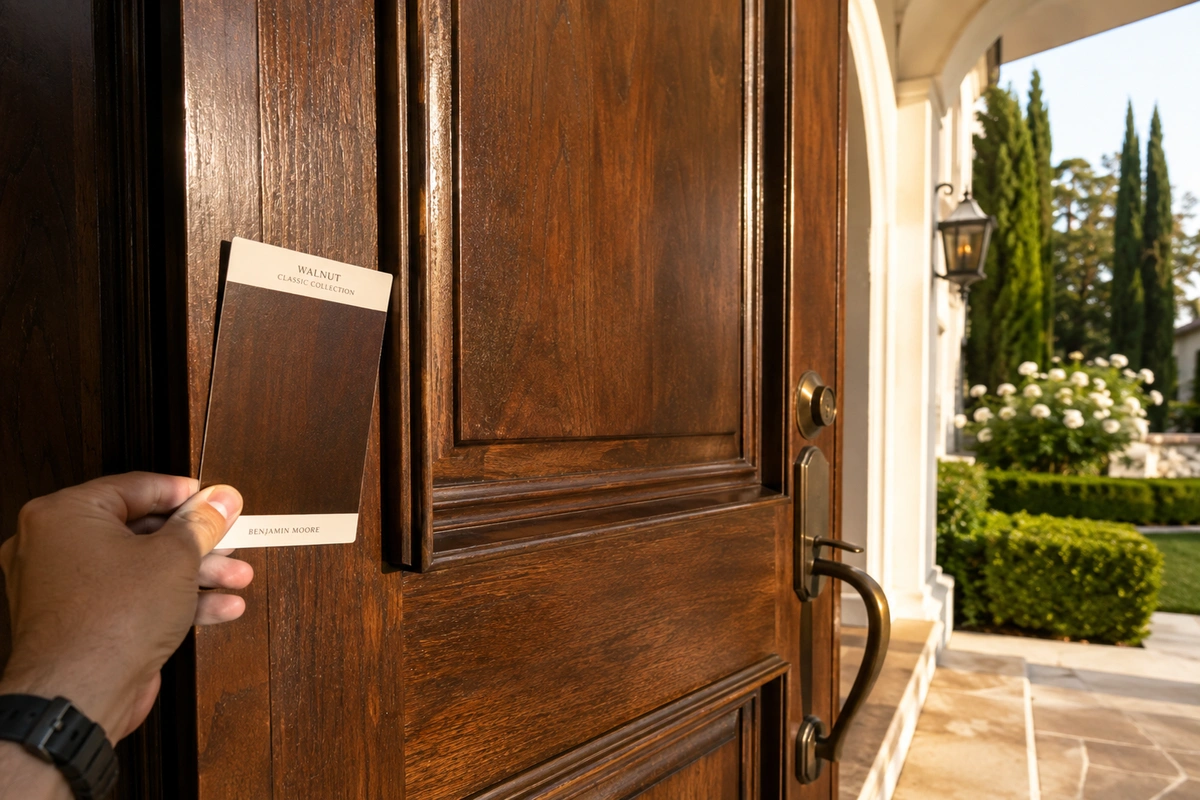
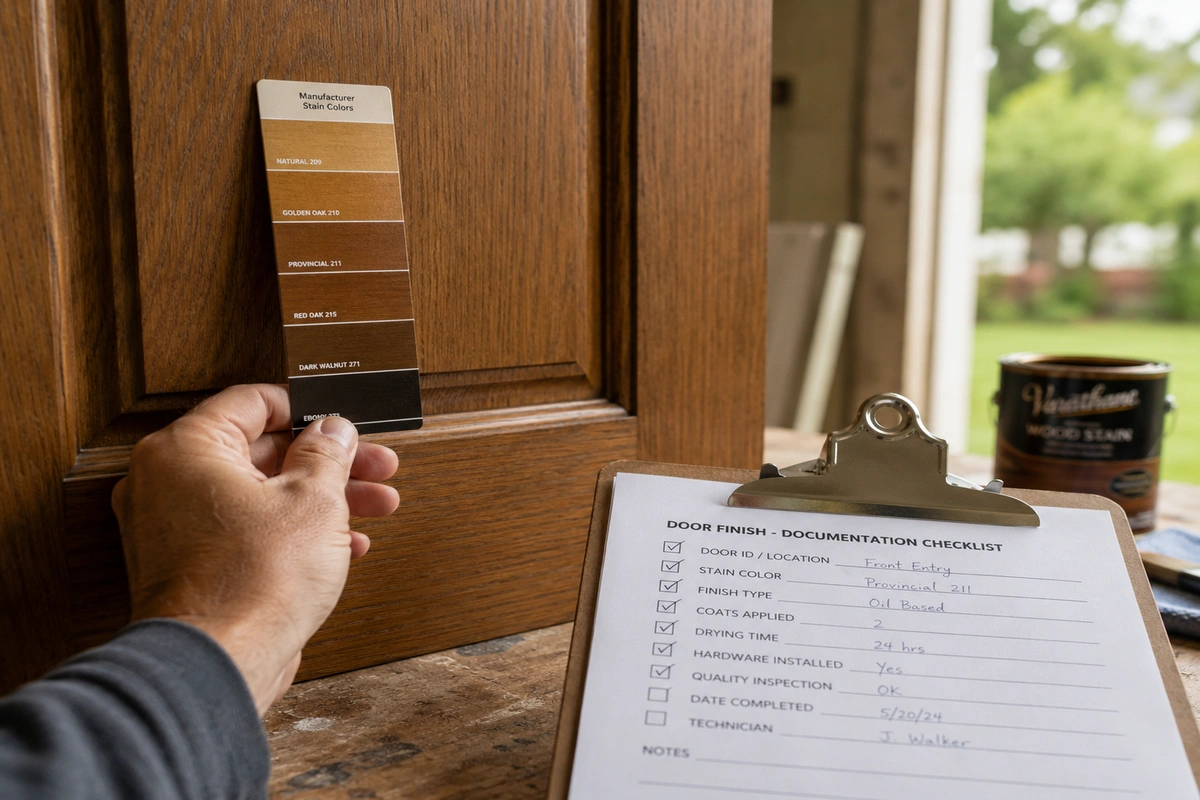
Architectural committees consistently reject applications that describe a color in general terms — “walnut” or “warm brown” isn’t specific enough. What clears review is a manufacturer name and code, paired with a physical sample or close-up photo, so the committee can compare it directly against the community’s approved palette.
Step 3: Expect a 30–45 Day Window
Many California associations operate on a 30-to-45-day response clock once a complete application is received. Incomplete submissions — missing a code, a sample, or a photo of the exact door — are a common reason applications stall or get automatically rejected, so it pays to submit everything the guidelines ask for on the first pass.
Step 4: Keep the Paperwork After Approval
Once approved, hang on to the written confirmation. If your community’s color palette changes down the road, an existing approved finish is typically protected under a grandfather provision — but only if you can produce the original approval when asked.
LA-Area HOA Communities We Work With Most
Several of the neighborhoods where we do the most refinishing work also carry some of the city’s more detailed architectural guidelines, simply because of how many of the properties sit inside gated associations or planned communities.
Door Refinishing Central & Creative Hubs
Bel Air
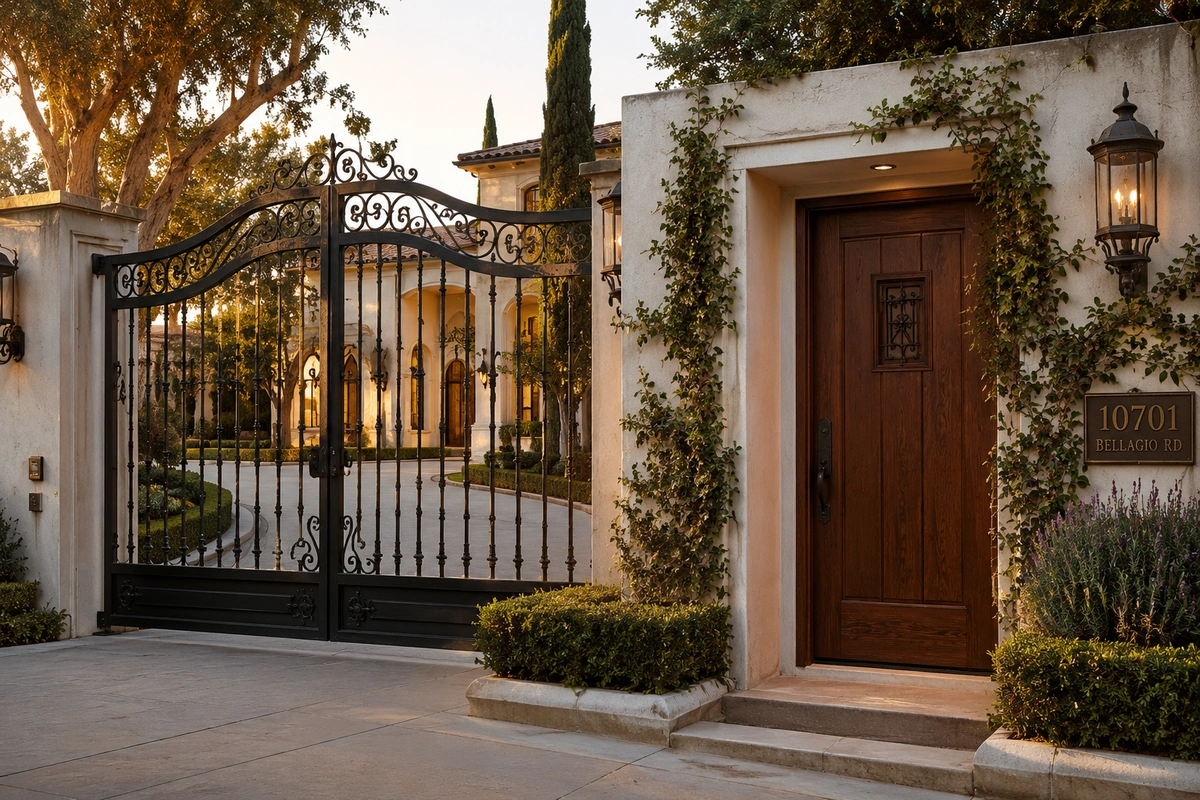
Bel Air’s estate-level HOAs and gate associations frequently require documentation for anything visible from the street, including entry doors and iron gates. Our Bel Air door and iron restoration work regularly includes matching a previously approved stain code so the refinish reads as maintenance rather than a change.
Brentwood
Brentwood’s classic architecture means many association guidelines specify not just a color but a finish sheen — satin versus semi-gloss, for example — since it affects how the door reads from the sidewalk. Our Brentwood refinishing projects are built around matching both.
Pacific Palisades
Palisades HOAs and post-rebuild design review boards often layer additional review on top of standard architectural approval, particularly for properties going through reconstruction. Our Pacific Palisades restoration services account for that added documentation step from the start.
Beverly Hills
Beverly Hills properties with HOA or planned-development oversight tend to expect premium documentation to match premium materials — full spec sheets, not just a paint chip. Our Beverly Hills luxury door refinishing work is documented to that standard as a matter of course.
What Counts as an “Approved” Finish in Most LA HOAs
Beyond color, most architectural guidelines that govern doors also specify sheen level, and some communities distinguish between the body of the door and any trim or hardware. A door refinished in the exact right hue but the wrong sheen — high-gloss where the guidelines call for satin — can still get flagged. This is one of the most common, and most avoidable, reasons a technically correct color match still comes back from committee with questions.
Door Refinishing Westside Elite Neighborhoods
Historic districts layered on top of an HOA add a further wrinkle. In these communities, a period-appropriate color or “heritage” palette may be mandatory regardless of what the HOA alone would otherwise allow, and changes can require sign-off from both the architectural committee and a local historic preservation body — a process that can add real time to an already multi-week review.
Common HOA Door Refinishing Mistakes That Trigger Violations
The refinishing work itself rarely causes HOA problems — the paperwork around it does. The most frequent issues we see are homeowners starting work before submitting an application, submitting a color description instead of a manufacturer code, assuming a “close enough” match to the existing color doesn’t need approval, and forgetting that garage doors, gates, and hardware are sometimes covered by the same guideline that governs the front door. Each of these is avoidable with the right documentation prepared before the first coat goes on.
A less obvious mistake is timing the project around the contractor’s schedule instead of the committee’s. Because many associations only meet monthly, or review applications in batches, submitting a week before you want the work done can mean waiting three or four additional weeks for the next review cycle. Building the approval window into the project timeline from the start — rather than treating it as a formality that will clear quickly — is one of the simplest ways to avoid a stalled project. It’s also worth double-checking whether your specific guidelines distinguish between the front-facing side of a door and the interior-facing side, since some associations only regulate the street-visible surface and allow more flexibility on the side facing the home’s interior or a private courtyard.
What a Typical HOA-Compliant Project Looks Like
Every association and every door is different, but most HOA-governed refinishing projects in Los Angeles follow a similar general shape once the paperwork is accounted for. Rather than dollar figures, it’s more useful to think in terms of scope and documentation load.
Door Refinishing Central & Downtown LA
| Project Scope | Typical Documentation Load | Realistic Timeline Including Review |
|---|---|---|
| Single door, matching existing approved color | Light — confirmation letter or photo match | Days to roughly two weeks, depending on committee meeting schedule |
| Single door, new color within approved palette | Moderate — manufacturer code, sample, photo | Three to six weeks, including a standard 30–45 day review window |
| Door plus garage door plus gate, coordinated finish | Moderate to heavy — full spec sheet covering every visible element | Four to eight weeks, depending on whether items are reviewed together or separately |
| Historic district property inside an HOA | Heaviest — architectural committee plus preservation board sign-off | Six weeks or more, occasionally longer around board meeting calendars |
Building in this kind of lead time up front tends to save far more frustration than trying to compress it after the fact, especially for homeowners hoping to have a refinished entry ready for a specific event or listing date.
How Our Team Handles HOA Documentation For You
When a project involves HOA or gate-association review, we treat the paperwork as part of the scope, not an add-on. That means confirming the manufacturer code and sheen level against your community’s approved palette before we start, providing physical samples or close-up photos formatted for an architectural review submission, and supplying written confirmation of the exact products used so you have a record on file if the topic ever comes up again — whether that’s for your own HOA archive or for a future resale disclosure.
Door Refinishing South Bay & Extended Metro
Real Client Reviews
★★★★★ “I waited a few weeks before writing this because I wanted to be sure. After rain, sun, and daily use, the door still looks fantastic. The finish isn’t sticky, blotchy, or overly shiny. It just looks like good wood taken care of properly. I recommend their services and I think they had fair pricing compared to the quality they provided.” — Ali Fazeli
★★★★★ “I’ve had a great experience with Door Stain. I first called them to refinish a front door that was in terrible shape. The results were stunning. I’ve now used them for multiple doors, and they never fail to impress. Their expertise in door refinishing makes all the difference.” — Alireza Hodhodi
★★★★★ “The utmost pleasure to work with California Door refinishing. They’re exceptionally professional and do the most beautiful work. I highly recommend anyone local and afar to try this business for refinishing jobs.” — Christine Meza
Frequently Asked Questions
Does door refinishing require HOA approval in Los Angeles, or only full replacement?
It depends on your community’s guidelines. Many associations treat a like-for-like refinish in an already-approved color as routine maintenance, while a color change or material swap typically requires a full submission.
How long does HOA architectural approval typically take for a door project in LA?
Many California associations work on a 30-to-45-day response window once a complete application is submitted. Missing documentation is the most common cause of delay.
Can an HOA deny a same-color refinish, or only color changes?
An HOA can only enforce standards actually written into its governing documents. If a same-color refinish isn’t listed as requiring review, the association generally can’t deny it on aesthetic grounds alone.
What documentation should I request from a refinishing company for my HOA application?
Ask for the manufacturer name and product code, a physical sample or close-up photo of the finish, and the sheen level, since color alone often isn’t enough for committee review.
Do gated communities like Bel Air and Brentwood have stricter door rules than typical LA HOAs?
Often, yes. Estate-level associations and gate communities frequently specify both color and sheen, and some review garage doors and hardware under the same guideline as the front door.
What happens if I refinish my door without HOA approval?
Outcomes vary by association, but unapproved changes can result in a violation notice, fines, or in some cases a requirement to redo the work in an approved finish — so it’s worth confirming requirements before starting.
Can an HOA force me to remove a completed refinishing job?
If the finish is found to violate the association’s written architectural standards, some HOAs can require the work be corrected or reversed, which is why pre-approval is worth the extra step.
Are there HOA rules specific to iron gates and security doors?
Some associations extend their door guidelines to gates, security screens, and hardware finishes, particularly in communities where these are visible from the street.
Does a historic district add extra approval steps on top of HOA review?
Yes. Properties inside both an HOA and a historic district may need sign-off from a preservation board in addition to the architectural committee, which can extend the timeline.
Can refinishing help me match a “grandfathered” door color approved years ago?
Yes — if you can locate the original approval or a sample of the existing finish, refinishing to match it is usually the simplest way to stay within a legacy approval without resubmitting for a new color.
Request Your Free HOA-Compliant Door Refinishing Quote
Whether your association needs a manufacturer color code, a physical sample, or full documentation for an architectural review packet, our team prepares it as part of every Los Angeles door refinishing project. Browse our full list of refinishing services, learn more about the team on our About page, or request a quote below and mention your HOA or community name so we can prepare the right paperwork from day one.
Text or Call +1 (619) 777-7171
[Quote form — see ready-to-paste code below]
Request Your Free HOA-Compliant Quote
Tell us your HOA or community name and we’ll prepare the right documentation from day one.