
Calirefinishing Team
Senior Door Refinishing Specialist · California Door Refinishing
⏱ 11 min read · Published September 2026 · Serving Los Angeles, CA
A tired-looking front door doesn’t always mean it’s time to shop for a replacement. In Los Angeles, most of the doors we’re called out to inspect — from Craftsman mahogany entries in Pasadena to iron-and-glass gates in Beverly Hills — are structurally fine underneath a finish that’s simply given up. The wood or metal is sound. The hardware still works. What’s failed is the surface layer standing between that material and the sun, salt air, and smog this city throws at it every day. Replacing a door in that condition means paying for a new slab, new hardware, and new installation labor to solve a problem that a Los Angeles door refinishing service could have fixed in a single day, at a fraction of the cost.
It’s an easy mistake to make, and an expensive one. Contractors who only sell replacement doors have every incentive to tell you a worn finish means a dead door, and homeowners who haven’t had a door professionally evaluated in years often assume the worst the moment they notice fading or a rough patch of paint. The reality, in our experience across hundreds of LA-area entries, garages, and gates, is that the large majority of “my door looks terrible” calls end in a refinish, not a replacement. Below are the five signs that point toward refinishing instead of replacing, the signs that point the other way, and how to tell them apart before you spend money on the wrong fix.
Refinishing vs. Replacing: How to Read the Difference
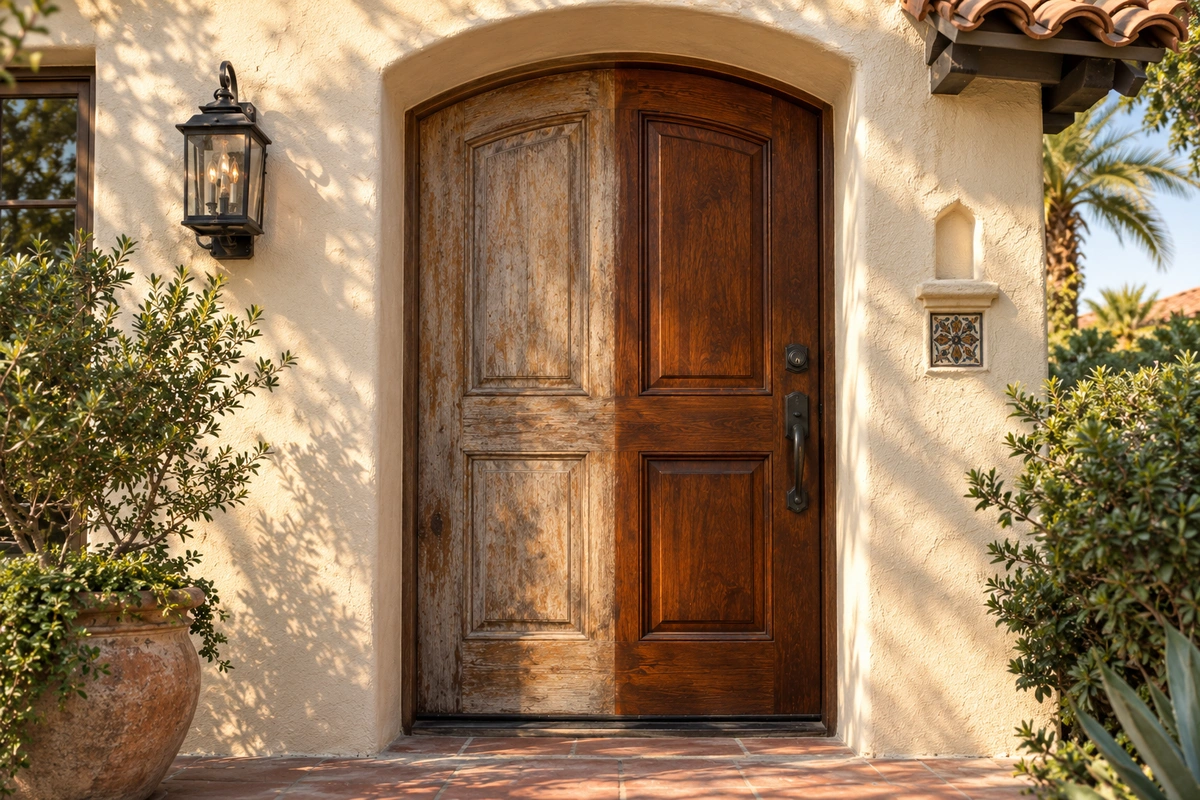
Every door decision comes down to one question: has the damage stayed on the surface, or has it reached the structure underneath? A refinishable door has failed at the finish level — the stain, sealant, paint, or clear coat has broken down, but the wood core, iron frame, or fiberglass shell is still solid, square, and properly seated in its frame. A door that needs replacement has failed at the structural level — the core material itself is compromised, and no amount of stripping, sanding, or re-coating will restore it. The five signs below all describe finish-level failure. If you read through them and think “that’s exactly my door,” refinishing is very likely the right call, and it’s worth getting our full range of restoration services evaluated against your specific door before assuming a replacement is necessary.
This distinction matters most on doors that are expensive or impossible to replace exactly as they are: custom mahogany entries, wrought iron gates with hand-forged detail, or original doors on a historic or architecturally significant home. On those doors especially, refinishing isn’t just the cheaper option, it’s often the only option that preserves what made the door valuable in the first place. A generic big-box replacement door can restore function, but it can’t recreate decades-old grain patterns or custom ironwork, which is exactly why so many homeowners in older LA neighborhoods choose to restore rather than replace once they understand the finish, not the door, is what actually failed.
Fading, Chalking, or Blotchy Discoloration From the LA Sun
This is the single most common reason homeowners across the LA basin call us, and it’s also the clearest sign that refinishing — not replacement — is the right move. Ultraviolet exposure breaks down the pigments and resins in a door’s finish long before it ever touches the wood or fiberglass beneath it. A door that once had a rich, even mahogany or walnut tone starts to look pale, patchy, or inconsistent, especially on south- and west-facing entries that catch direct afternoon sun for most of the year. Fiberglass doors show a related symptom: a chalky, whitish residue that wipes off on your hand, which is the factory gel coat oxidizing under UV load.
None of this means the door itself is failing. It means the protective layer is gone, which is actually urgent to address precisely because bare, unprotected wood or gel coat degrades much faster than a properly finished surface. A full strip-sand-and-refinish cycle removes the failed layer down to clean material and rebuilds a UV-stable topcoat in its place, which is a very different (and far less expensive) job than tearing out the door and reframing the opening.
A Dry, Rough, or Micro-Cracked Finish
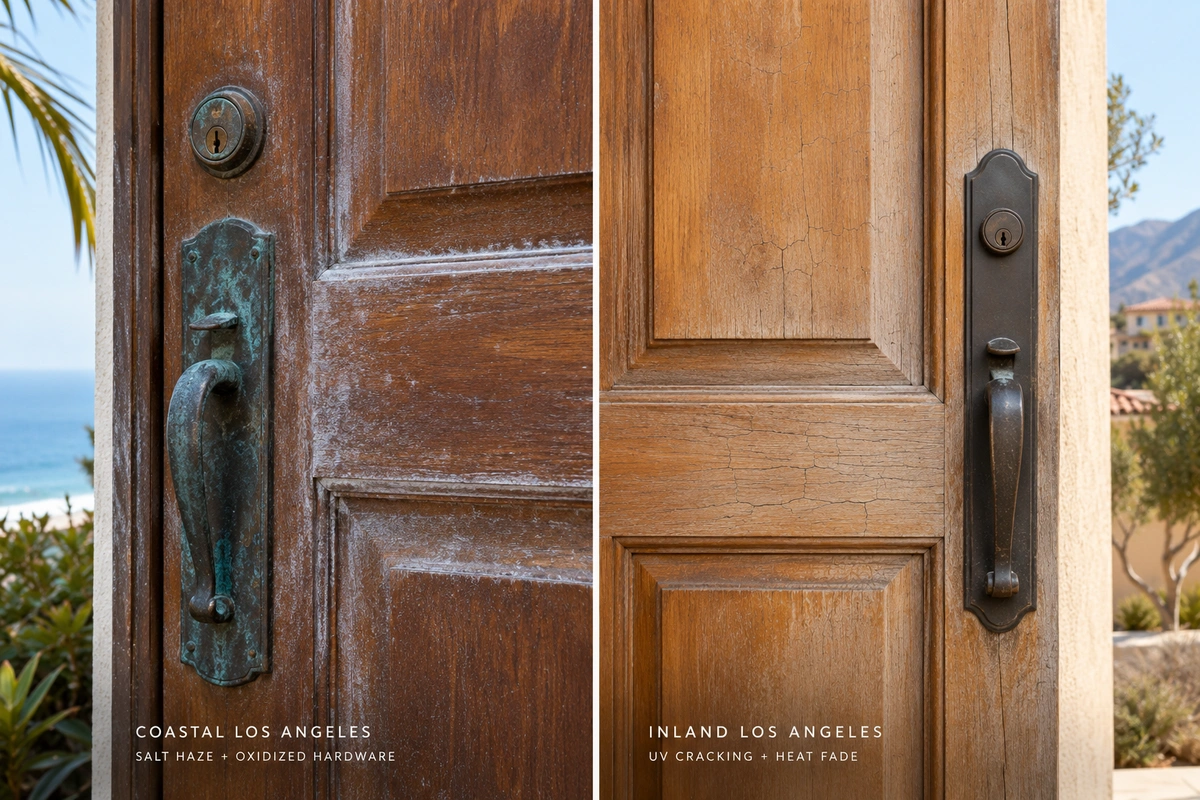
Run your palm across the door’s surface in direct light. If it feels dry, slightly rough, or chalky rather than smooth, or if you can see a fine network of hairline cracks (sometimes called “alligatoring”) across the finish, that’s the clear coat or paint film reaching the end of its service life. This typically shows up a few years before visible fading becomes obvious, which makes it a useful early-warning sign if you’re trying to stay ahead of bigger repairs.
The distinction that matters here is depth. Hairline surface cracking that hasn’t penetrated into the wood grain is a finish problem, full stop — it’s the topcoat losing flexibility and adhesion, not the door losing integrity. We see this constantly on garage door refinishing projects, where large, flat wood panels expand and contract with LA’s daily temperature swings and eventually crack the finish before the wood itself is ever at risk. As long as the cracking stays superficial, this is squarely in refinishing territory: strip the compromised layer, sand the surface smooth, and reseal before moisture has a chance to find its way into the exposed grain.
Isolated Water Spotting or Dark Staining
Dark rings, cloudy patches, or streaking near the bottom rail or around a window insert usually mean moisture has gotten past the finish and sat in the wood fibers, most often from irrigation overspray, morning dew pooling on a threshold, or a gutter that dumps water near the entry. It looks alarming, and it should be addressed, but isolated surface staining is one of the most refinishable problems a door can have.
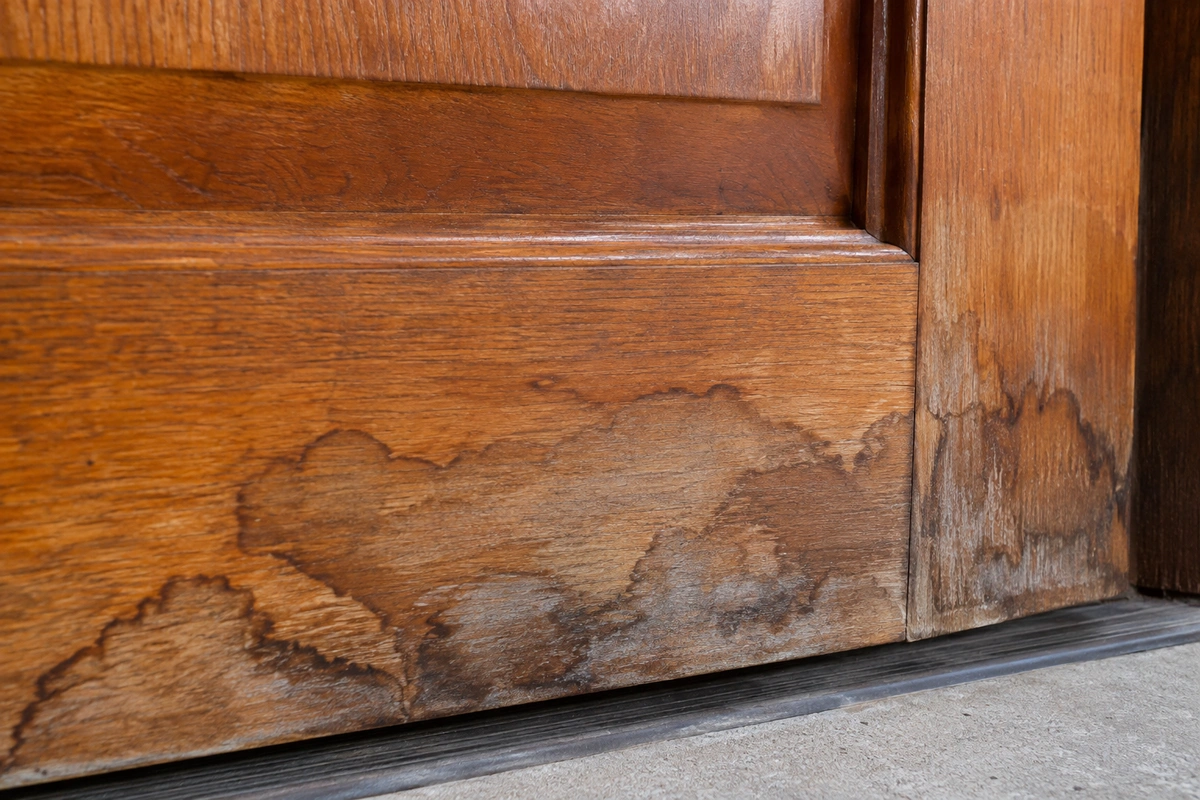
The test is whether the wood underneath is still firm. Press a fingernail or the tip of a key into the stained area. If the wood resists and feels solid, the moisture hasn’t broken down the fiber structure yet — it’s a cosmetic and finish-level issue that sanding, targeted bleaching or spot-treatment, and a fresh Southern California price guide-tier refinish will fully resolve. If the wood feels soft, spongy, or gives way under light pressure, that’s a different situation entirely, and we cover it in the replacement section below.
Dull, Oxidized, or Lightly Rusting Iron and Metal Accents
Wrought iron gates, decorative scrollwork, security screens, and metal garage doors face a different aging process than wood, but the same underlying logic applies. Paint chalking, a dull or matte finish where there used to be a sheen, and light surface rust around hinges, rivets, or decorative joints are all signs of a failed protective coating, not a failed structure. This is especially common on properties within a few miles of the coast, where airborne salt accelerates oxidation on anything metal.
Refinishing iron and metal doors involves mechanically removing the rust and failed coating down to clean metal, treating any remaining corrosion with a converting primer, and rebuilding the finish with anti-corrosive, UV-stable topcoats designed for exterior exposure. This restores both the appearance and the protective barrier, and it’s dramatically less expensive than replacing custom ironwork, which is often difficult to source or duplicate exactly on properties with older or architecturally specific gates.
The Door Still Opens, Closes, Locks, and Seals Correctly
This is the sign homeowners most often overlook, because it’s about what the door does, not just how it looks. If your door still swings freely on its hinges, latches and locks without forcing, and closes flush against the frame without a persistent gap, that tells you the door slab, hinges, and frame are all still properly aligned. Mechanical function is one of the most reliable indicators that a door’s structure is intact, regardless of how faded or worn the finish looks.
A door that still performs mechanically but looks tired cosmetically is close to the ideal refinishing candidate: all of the expensive, hard-to-fix elements (fit, alignment, hardware, weatherproofing at the frame) are already working, and the entire scope of work is limited to the surface. That’s the combination that makes a same-day, on-site refinish possible instead of a multi-week replacement and installation project.
When Replacement Really Is the Right Call
Refinishing is the right answer for the vast majority of doors we inspect, but it isn’t the answer for every door. Replacement becomes the more sensible choice when the damage has moved past the finish and into the door’s core structure. Watch for:
- Soft, spongy, or crumbling wood — press-test any stained or discolored area; if the wood gives way, rot has set into the fiber and refinishing cannot rebuild lost material
- Visible warping or bowing across the face of the door, which usually means moisture has penetrated deep enough to distort the panel permanently
- A door that no longer closes, latches, or seals even after basic adjustment, which points to frame or slab movement rather than a surface problem
- Delamination on fiberglass doors, where the outer skin separates from the foam core, visible as bubbling or a hollow-sounding tap
- Deep structural cracks that run through the full thickness of a panel, not just the surface finish
If any of these describe your door, refinishing genuinely won’t solve the underlying problem, and we’ll tell you that directly during a free on-site evaluation rather than trying to sell a refinish that won’t hold up. That honesty matters because a refinish applied over a structurally compromised door doesn’t just fail to fix the problem, it can actually mask it, letting rot or delamination continue to spread underneath a fresh-looking surface until the damage is far more extensive and far more expensive to correct than it would have been if it had been caught and replaced early. When we recommend replacement, it’s because refinishing would cost you money now and cost you more money later.
Why Los Angeles Doors Age Differently by Neighborhood
Two doors of identical age and material can fail in completely different ways depending on where in the LA basin they sit, which is why a one-size-fits-all national “signs your door needs help” article never quite fits a Los Angeles home.
Coastal Salt-Air Oxidation
Properties in Malibu door restoration, Santa Monica door refinishing, and Brentwood door restoration service areas sit inside a marine layer that carries airborne salt well inland from the shoreline. That salt accelerates finish breakdown on wood and drives oxidation and rust on iron and metal hardware far faster than an inland home would see. Doors here often need refinishing on a shorter cycle, but they’re also excellent refinishing candidates, since the salt attacks the finish long before it threatens the underlying material.
Inland Heat, UV, and Thermal Expansion
Move inland toward Beverly Hills door refinishing, DTLA door refinishing, and the urban heat islands of the Valley, and the primary stressor shifts from salt to sun and thermal cycling. Daily heat swings cause wood panels to expand and contract repeatedly, which is what drives the surface cracking described in Sign #2, while sustained UV exposure is the main driver of the fading and chalking in Sign #1. Homes in West Hollywood door refinishing and Culver City door restoration service areas tend to see this pattern as well, sitting in the transitional zone between coastal moisture and inland heat.
Refinishing vs. Replacing at a Glance
| Factor | Professional Refinishing | Full Door Replacement |
|---|---|---|
| Best for | Faded, dry, chalking, lightly stained, or dull-metal doors with a sound structure | Rotted, warped, delaminated, or non-functioning doors |
| Typical timeline | Completed on-site, often in a single day | Days to weeks, including custom ordering and installation |
| Investment tier | Lower-tier, cosmetic and protective restoration pricing | Higher-tier, includes materials, framing work, and labor |
| Addresses root cause? | Yes — removes failed finish, repairs minor surface issues, rebuilds protection | Yes — but only necessary when the core structure itself has failed |
| Preserves original architecture? | Yes — ideal for custom, historic, or hard-to-match doors and ironwork | No — original material and character are lost |
| Disruption to household | Minimal; door typically stays on its hinges throughout | Higher; may involve frame removal and temporary security gaps |
What Our On-Site Refinishing Process Involves
Once we’ve confirmed a door is a refinishing candidate rather than a replacement case, the process itself is straightforward and designed to minimize disruption to your home:
- On-site evaluation — we inspect the door in person (or from submitted photos) to confirm the damage is finish-level, not structural, before recommending refinishing
- Stripping and surface preparation — the failed stain, paint, or clear coat is removed down to clean, sound material
- Repair of minor surface issues — small dents, hairline cracks, or light surface rust are addressed before refinishing begins
- Staining or coating — a finish matched to the door’s material and your home’s aesthetic is applied, using UV-inhibiting, marine-grade, or anti-corrosive products depending on the door type and neighborhood exposure
- Sealing and protective topcoating — the final protective layer is built up to withstand LA’s specific mix of sun, salt air, or heat
- Final inspection — hardware function, seal quality, and finish evenness are checked before we consider the job complete
Most residential doors are completed on-site in a single day, without ever removing the door from its hinges.
How to Extend Your Refinished Door’s Lifespan
A professional refinish resets the clock on your door, but a few habits stretch that investment considerably further, especially given how hard the LA climate works against any exterior finish. None of these require special skills or products beyond what most homeowners already have on hand.
- Rinse salt residue off coastal-facing doors every few weeks if you’re within a mile or two of the shoreline; a quick hose-down or damp wipe-down prevents salt crystals from sitting against the finish and accelerating oxidation
- Keep sprinklers and irrigation lines pointed away from the door, since repeated direct overspray is one of the most common causes of the water staining described in Sign #3
- Re-apply a maintenance coat every couple of years rather than waiting for full failure; a light re-coat on an otherwise healthy finish is far faster and less expensive than a full strip-and-refinish later
- Check weatherstripping and seals annually, since a failing seal lets moisture reach the door edge even when the face of the door still looks fine
- Keep hardware lubricated and hinges adjusted, which prevents the kind of misalignment that eventually turns a cosmetic issue into a mechanical one
Doors that get this kind of light, occasional attention typically go years longer between full refinishing cycles than doors that are simply left alone until a problem becomes visible.
Frequently Asked Questions About Refinishing vs. Replacing a Door
These are the questions we hear most often once a homeowner has confirmed their door is a refinishing candidate rather than a replacement case, covering cost, materials, durability, and timeline.
How much does refinishing typically cost compared to a full door replacement?
Refinishing is priced by the scope of surface work involved — how much stripping, repair, and coating a specific door needs — and consistently lands in a lower investment tier than replacement, which carries the added cost of a new door slab, hardware, and installation labor. For a detailed breakdown by material and condition, see our Southern California price guide.
Can fiberglass and metal doors be refinished, or only solid wood?
Both can be refinished. Fiberglass doors respond well to specialized gel-stain systems that restore a realistic wood-grain appearance once the factory gel coat has chalked or faded. Iron and metal doors and gates are refinished through rust removal, corrosion treatment, and anti-corrosive topcoating rather than staining, but the underlying logic — protect sound material instead of replacing it — is the same.
Will a refinished door hold up in a coastal neighborhood like Malibu or Santa Monica?
Yes, provided the right materials are used. Coastal properties need marine-grade sealants and UV-inhibiting topcoats specifically formulated to resist salt-air oxidation, which is different from the products used further inland. This is why we adjust our material selection by neighborhood rather than applying one standard finish citywide.
What if only one part of my door, like the bottom rail, shows damage?
Localized damage doesn’t require refinishing the entire door structurally, but for an even, uniform appearance, the full face is typically stripped and refinished together rather than patching a single section, which can leave a visible mismatch in tone and sheen.
How long does a professional refinish take from start to finish?
Most single-door residential projects are completed on-site in one day, since the door generally stays on its hinges throughout the process. Larger projects, such as double-door entries or multiple garage doors, may take longer depending on scope.
If my HOA requires approval for exterior work, does refinishing count?
Many HOAs treat refinishing differently than replacement since it preserves the original approved door rather than introducing a new one, though requirements vary by community. If you’re navigating that process, our HOA approval guide walks through what to expect.
Request Your Free Door Refinishing Quote
If your door matches any of the five signs above, the most reliable next step is a direct evaluation rather than guessing from a checklist. Upload a few photos below and our team will tell you honestly whether your door is a refinishing candidate or genuinely needs replacement — and if you manage a rental unit or HOA property, our guides on rental property door wear and how to choose a door refinishing company are worth a read as well. For neighborhood-specific service details, visit our Central & Creative Hubs door refinishing, Valley Residential door refinishing, or South Bay & Extended Metro door refinishing pages, or meet our restoration team to see the craftsmanship behind every project.
Get Your Free Door Refinishing Quote
Upload a photo and tell us about your door — we’ll tell you honestly if it needs refinishing or replacing.