
Senior Door Refinishing Specialist · California Door Refinishing
⏱ 12 min read · Published September 2026 · Serving Los Angeles, CA
If you’ve been putting off refinishing a faded front door, a sun-bleached garage door, or a rusting iron gate because you’re waiting for “the right season,” the honest answer is more nuanced than a single window on the calendar. Los Angeles doesn’t have one climate — it has a dozen overlapping ones, and the ideal timing for a coastal home in Malibu is different from the ideal timing for a canyon estate in Bel Air or a mid-century property in Sherman Oaks. This guide breaks down exactly what temperature, humidity, wind, and rainfall do to stain and clear coat, month by month, so you can plan a project that actually cures the way it’s supposed to — instead of guessing.
Homeowners usually ask this question for one of two reasons: they’re planning ahead and want to hit the ideal window, or they already have a damaged door and want to know if it’s safe to fix it right now. Both answers are covered below, along with the neighborhood-by-neighborhood adjustments that make Los Angeles trickier to plan around than almost anywhere else in the country.
Why Timing Actually Matters for Door Refinishing in Los Angeles
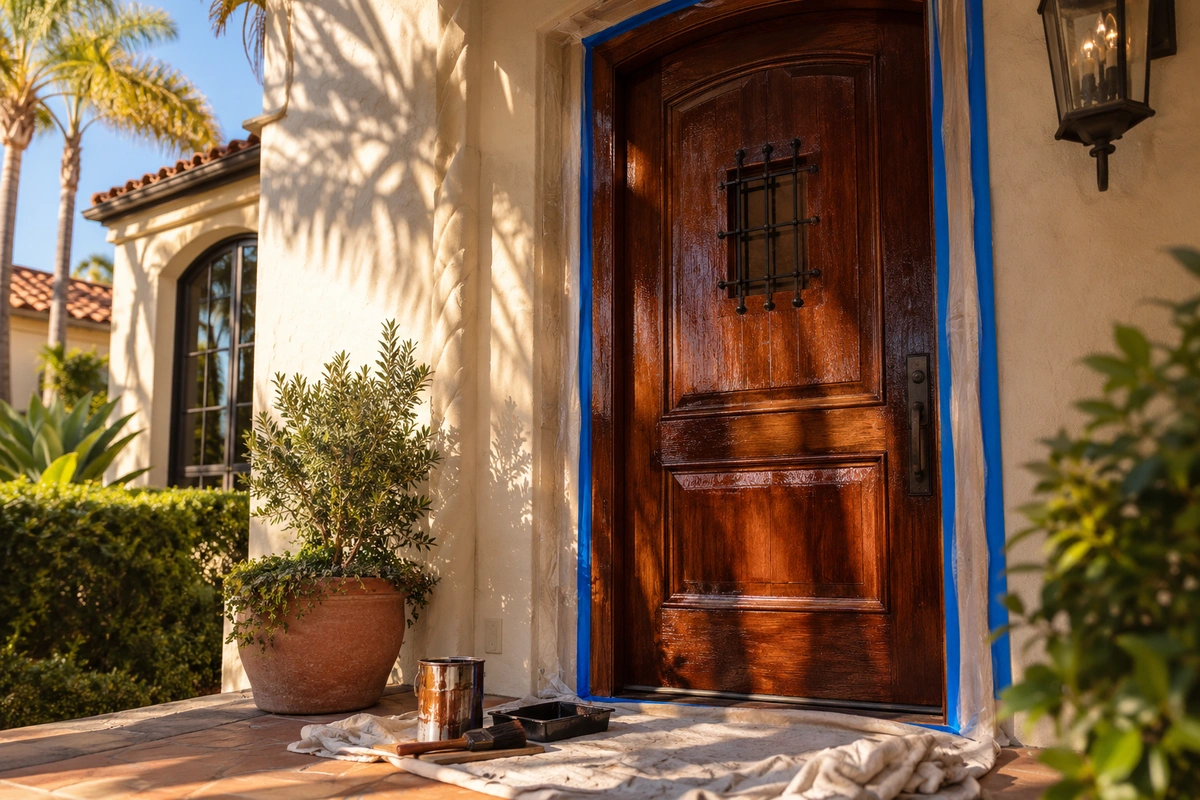
Refinishing isn’t paint. A quality exterior stain and topcoat system needs to penetrate the wood fibers, level out, and cure through several chemical stages before it can stand up to another year of sun and salt air. Rush that process by staining in triple-digit heat, or apply it during a damp marine-layer morning, and the finish can skin over on the surface while staying soft underneath — a setup for bubbling, blotching, and early peeling. Timing isn’t about superstition; it’s about giving the coating system the window it was engineered for, so the labor and materials you’re paying for actually last.
That’s true whether the target is a front door refinishing project, a full garage door refinishing job, or an iron gate. Larger surfaces like garage doors are especially sensitive, since more square footage means more time exposed to changing conditions during a single application.
Poor timing doesn’t always fail immediately, either. A stain applied in marginal conditions can look acceptable for the first few weeks, then start showing hairline cracking, dull patches, or uneven sheen six to twelve months later — right around the point where it’s expensive to fix without stripping the whole surface back down to bare wood again. That delayed failure pattern is part of why we treat timing as a technical decision rather than a scheduling convenience.
The Ideal Temperature and Humidity Window for Staining a Door
Across the finishing industry, the accepted rule of thumb for oil-based and gel stains is a surface and air temperature between roughly 55°F and 90°F, with relative humidity somewhere between 40% and 70%. Outside that range, one of two things tends to happen: cold slows the cure and can leave the finish tacky for days, while excess heat causes the solvents to flash off too fast, so the stain sits on top of the wood instead of soaking in evenly.
| Condition | Ideal Range for Staining | What Happens Outside the Range |
|---|---|---|
| Air/Surface Temperature | 55°F – 90°F | Below 55°F: slow, incomplete cure. Above 90°F: flash-drying, lap marks, poor penetration |
| Relative Humidity | 40% – 70% | Below 40%: stain dries before it levels. Above 70%: trapped moisture, blotching, hazing |
| Direct Sunlight on the Surface | Avoid during application | Uneven drying, visible lap lines, reduced adhesion |
| Wind | Calm to light breeze | Gusty conditions carry dust and debris into wet finish; also accelerates surface drying unevenly |
In most of the country, that window lines up neatly with spring and fall. In Los Angeles, it’s more complicated, because our “seasons” are really microclimates layered on top of each other — which is exactly why we tailor our approach differently for Westside and coastal properties than we do for Valley residential homes.
A Month-by-Month Guide to Door Refinishing Weather in Los Angeles
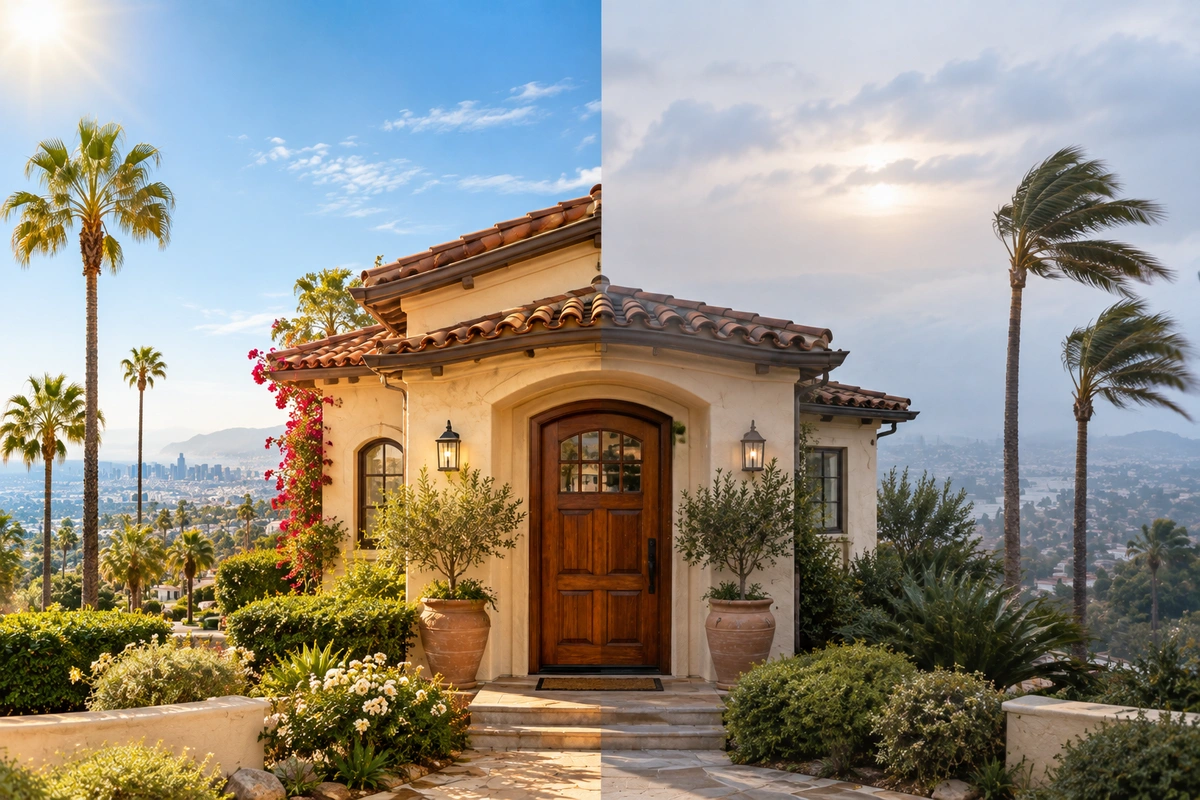
Here’s how the calendar actually plays out across a typical Los Angeles year, factoring in temperature, humidity, and the two wildcard weather patterns that matter most here: the coastal marine layer and the Santa Ana winds.
Spring (March–May): The Traditional Sweet Spot
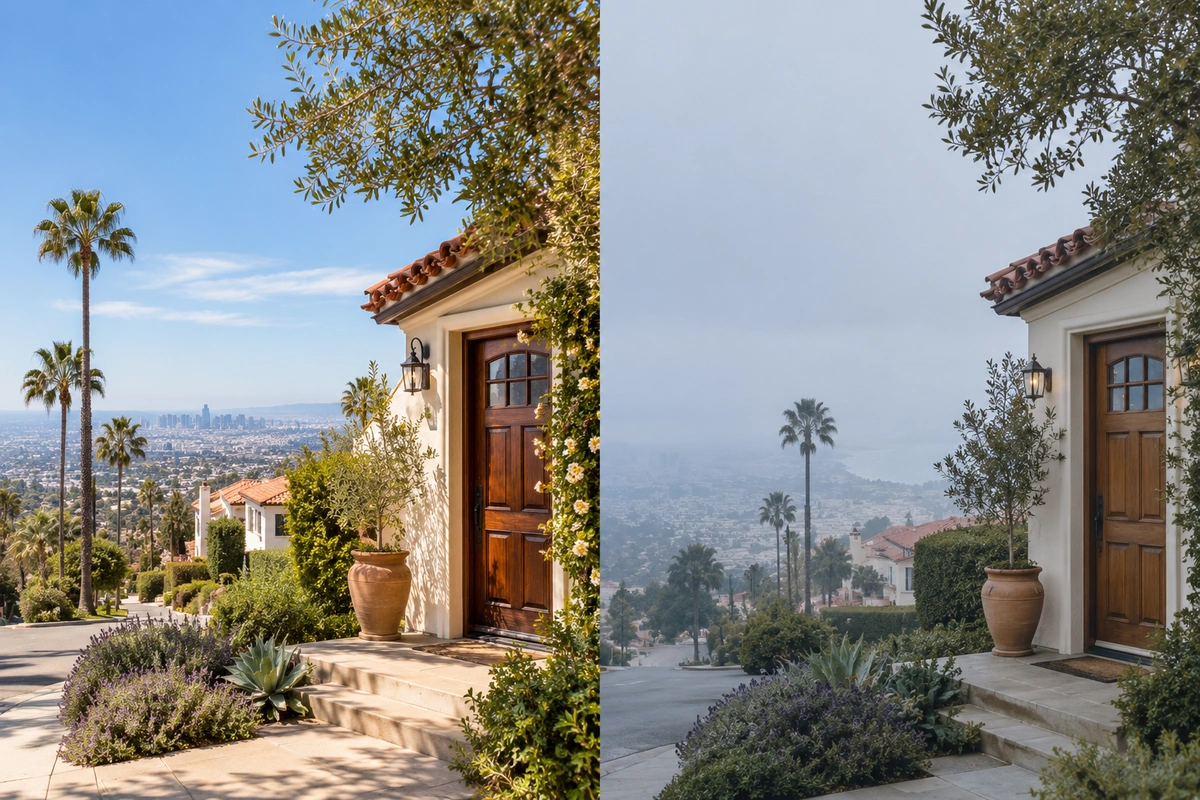
March through May is close to textbook staining weather for most of the basin. Daytime highs generally sit in the high-60s to mid-70s, overnight lows stay mild, and rainfall drops off sharply after March. Humidity is moderate outside of the coastal strip. This is a strong window for inland and hillside neighborhoods, though late spring is also when the marine layer starts creeping in along the coast most mornings — which matters if your project is in Santa Monica door refinishing or Marina del Rey door refinishing, since we schedule those applications for the afternoon once the fog burns off rather than first thing in the morning.
Summer (June–September): Heat, Marine Layer, and Fast-Drying Risk
June brings “June Gloom” — overcast, damp mornings along the coast that can push humidity above the ideal range before burning off by midday. Inland and Valley areas skip the gloom entirely and head straight into heat: July and August regularly push past 85°F to 90°F in Encino door refinishing, Tarzana door refinishing, and Burbank door refinishing, with surface temperatures on a west-facing door running well above the air temperature. That’s above the ideal ceiling for most stains, which is why summer refinishing in the Valley almost always needs to happen in early morning before the heat builds, using products formulated to resist flash-drying.
Fall (October–November): Crisp Air, but Santa Ana Season Begins
Early fall often delivers some of the most stable, moderate days of the year — cooler than summer, still dry, with humidity trending down. The catch is timing: this is also when Santa Ana wind season typically begins ramping up (more on that below), so scheduling around specific wind events becomes part of the plan rather than an afterthought.
Winter (December–February): Rain Windows and Cold Mornings
Winter is Los Angeles’s wet season, and it’s also when the region sees its coolest mornings. Neither rain nor cold temperatures below roughly 50°F are compatible with a same-day stain-and-seal application. That said, winter isn’t a dead zone — it’s simply a season where scheduling around a confirmed multi-day dry stretch matters more than it does in July.
| Month | Avg. High / Low | Typical Humidity | Key Factor | DIY Timing Verdict |
|---|---|---|---|---|
| Jan – Feb | 67°F / 49°F | 55–60% | Peak rain season; Santa Ana events still possible | Wait for a confirmed dry stretch |
| Mar – Apr | 70°F / 54°F | 55–65% | Rain tapering off; stable conditions returning | Good window inland; watch coastal fog |
| May – Jun | 77°F / 60°F | 60–65% (coastal higher) | Marine layer / “June Gloom” along the coast | Strong inland; schedule coastal work for afternoon |
| Jul – Aug | 82°F / 63°F | 50–55% | Peak inland heat; surface temps exceed air temps | Early-morning application only in the Valley |
| Sep – Oct | 80°F / 62°F | 50–55% | Warmest average temps; Santa Ana onset | Good, but plan around wind advisories |
| Nov – Dec | 71°F / 53°F | 50–55% | Santa Ana wind season peaks; occasional early rain | Good on calm days; avoid active wind events |
Santa Ana Wind Season and Why It Complicates DIY Timing
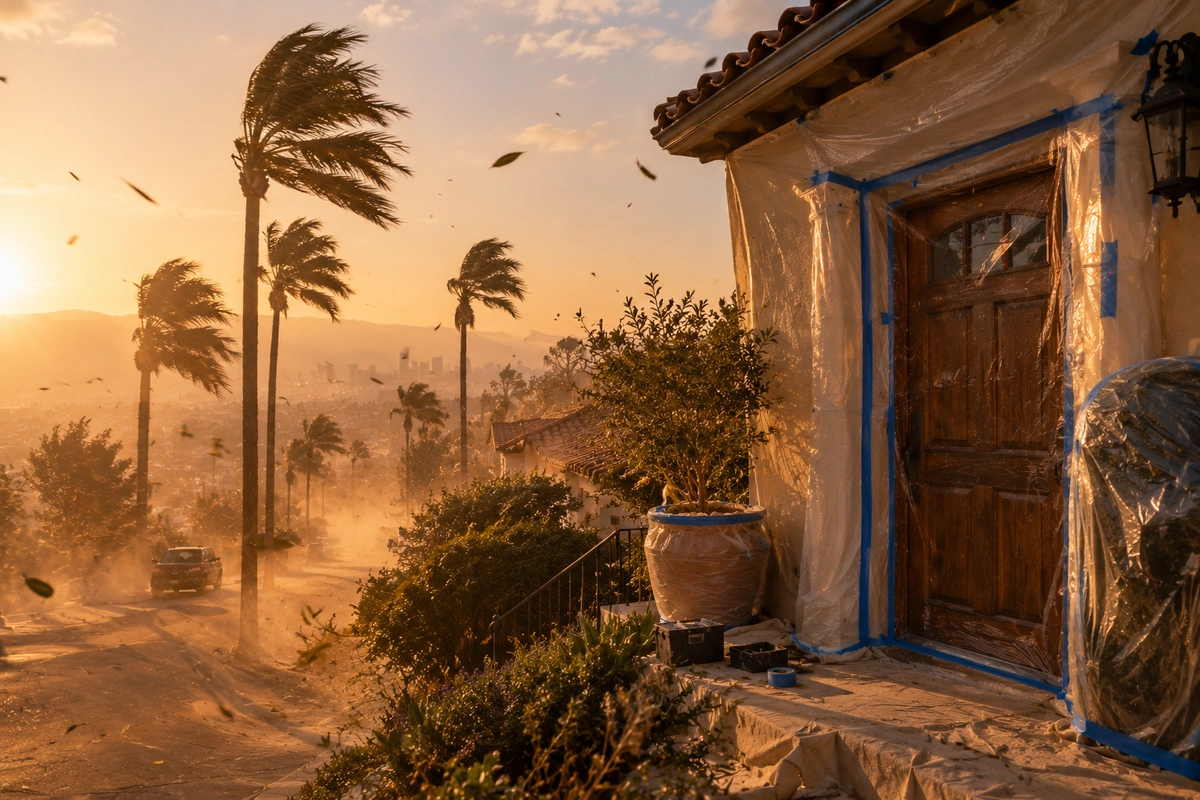
Santa Ana winds are the piece of Los Angeles weather that most generic “best time to stain a door” advice never accounts for, because it’s a Southern California-specific phenomenon. These hot, bone-dry winds flow from the inland deserts toward the coast, typically starting in early fall and continuing through winter, with the highest frequency of events in November and December. During an active Santa Ana event, humidity can crash into the single digits and gusts can exceed 40–60 mph.
For a refinishing project, that’s a double problem: the dry, gusty air pulls moisture out of a fresh stain almost as fast as it’s applied, and windborne dust and debris can embed in a wet clear coat and ruin the finish. It’s also fire-weather season, which affects work near hillside and canyon properties in Bel Air door refinishing, Hollywood Hills door refinishing, and Pacific Palisades door refinishing. Rather than picking “October” or “November” as a blanket answer, we check the specific week’s wind forecast before scheduling any exterior application during this stretch of the year.
How Los Angeles Microclimates Shift the “Best” Answer by Neighborhood
Because “Los Angeles weather” isn’t really one thing, the ideal timing genuinely shifts depending on where the door is:
- Coastal and beach-adjacent properties — Malibu door refinishing, Manhattan Beach door refinishing, and Redondo Beach door refinishing — deal with the marine layer and salt-air humidity year-round, so afternoon scheduling matters more than which month it is.
- Inland Valley homes, including Sherman Oaks door refinishing properties, see the widest temperature swings, which makes spring and early fall the most forgiving windows, with summer requiring early starts.
- Hillside and canyon estates across our Westside Elite service area, such as Culver City door refinishing, face both fire-season wind risk and the general Westside marine influence, so timing decisions there weigh wind forecasts as heavily as temperature.
- Dense urban and downtown properties, including our Central & Downtown LA door refinishing territory, contend with a heat-island effect and higher ambient particulate levels, both of which push us toward early-morning application windows even outside peak summer.
- South Bay and extended metro homes, covered under South Bay & Extended Metro door refinishing, mix coastal humidity with more inland-style heat swings depending on distance from the water.
Why Professional Refinishing Isn’t Limited by the Calendar
Here’s the practical takeaway: while the “textbook” answer favors spring and early fall, our crews complete high-quality refinishing projects across Los Angeles in every month of the year. The reason is product selection and scheduling discipline rather than luck. We use marine-grade sealants and UV-inhibiting topcoats engineered for a wider working range than retail-grade stains, and we build every project around same-day, on-site containment — masking hardware and surrounding surfaces so the work isn’t at the mercy of a full week of “perfect” weather.
That flexibility extends across every surface type we handle, from garage door refinishing and iron gates to interior add-ons like wood floor refinishing, which many homeowners schedule alongside an exterior door project once our crew is already on-site.
How Weather Timing Changes by Door Material
Not every material responds to heat, humidity, and wind in the same way, which is part of why “the best time of year” isn’t a single universal answer even for two doors on the same street.
Solid wood doors (mahogany, oak, cedar) are the most weather-sensitive. Wood is porous and moves with humidity, expanding slightly when damp and contracting when dry. Staining during a humidity spike — a coastal marine-layer morning, for instance — can trap moisture under the topcoat, leading to cloudiness or slow-curing tackiness. Staining during a dry Santa Ana event can cause the stain to skin over before it penetrates the grain, leaving a flat, uneven color.
Iron and metal doors and gates care less about humidity and more about temperature swings during the priming stage. Anti-rust primers need a stable temperature to bond properly to bare metal; rapid heating and cooling — common during a Santa Ana event or a sudden coastal fog rollback — can affect adhesion before the primer fully sets.
Fiberglass doors are the most forgiving of the three, since the base material doesn’t expand and contract with moisture the way wood does. The main risk with fiberglass is heat: gel stains and clear coats can flash-dry on a hot afternoon surface, leaving visible lap marks where one section was worked slightly before the next.
Because of these differences, our crews don’t apply a single seasonal rule across every job — a wood front door and an iron security gate on the same property may get scheduled for different times of day, even during the same week.
Signs You Shouldn’t Wait for “Perfect” Weather
Some conditions are urgent enough that waiting for an ideal seasonal window costs more than it saves. Consider scheduling sooner rather than later if you notice:
- Peeling or flaking clear coat that’s exposing bare wood to the elements
- Visible water staining or soft spots near the bottom rail or threshold
- A garage door with cracked, chalking finish ahead of the next heat wave or Santa Ana event
- An iron gate with active rust bloom, which spreads faster the longer it’s left untreated
- A door you’re trying to get refinished before a sale, refinance appraisal, or event
In these cases, a door refinishing company that can adapt its process to the current week’s conditions is worth more than an arbitrary calendar date.
Our Proven Process for Timing and Executing Your Project Right
Every project starts with an on-site inspection where we evaluate the door’s exposure — sun direction, coastal proximity, coverage from eaves or overhangs — and cross-check the coming week’s forecast before locking in a date. From there, our crew follows the same structured stripping, sanding, staining, and multi-coat sealing process regardless of season, adjusting only the drying windows and application timing to match the day’s actual conditions rather than the generic calendar.
If you’re weighing cost alongside timing, our Southern California price guide walks through what typically drives the estimate. HOA communities can also review our HOA approval guide before scheduling, and rental property owners may find our rental property refinishing guide useful for budgeting turnover timing around tenant move-outs.
We also track short-term forecasts the same week we’re scheduled to work, not just the seasonal averages. A generally “good” month can still have a three-day heat spike or an unexpected wind advisory, and a generally “risky” month can hand us a stretch of calm, mild days that are perfectly workable. That day-of flexibility, more than the calendar, is what actually determines whether a project gets a durable finish — and it’s the reason our estimators ask about your property’s sun exposure and neighborhood microclimate before ever locking in a date.
What Los Angeles Homeowners Say About Our Work
“I waited a few weeks before writing this because I wanted to be sure. After rain, sun, and daily use, the door still looks fantastic. It just looks like good wood taken care of properly.” — Ali Fazeli
“I’ve had a great experience with Door Stain. I first called them to refinish a front door that was in terrible shape. The results were stunning.” — Alireza Hodhodi
“The utmost pleasure to work with California Door refinishing. They’re exceptionally professional and do the most beautiful work.” — Christine Meza
Get Your Free Seasonal Door Refinishing Quote in Los Angeles
Not sure whether this month’s weather is a good fit for your project? Send us a few photos and your neighborhood, and we’ll tell you honestly whether now is a good window or whether we’d recommend waiting a few weeks for a wind event or rain system to clear.
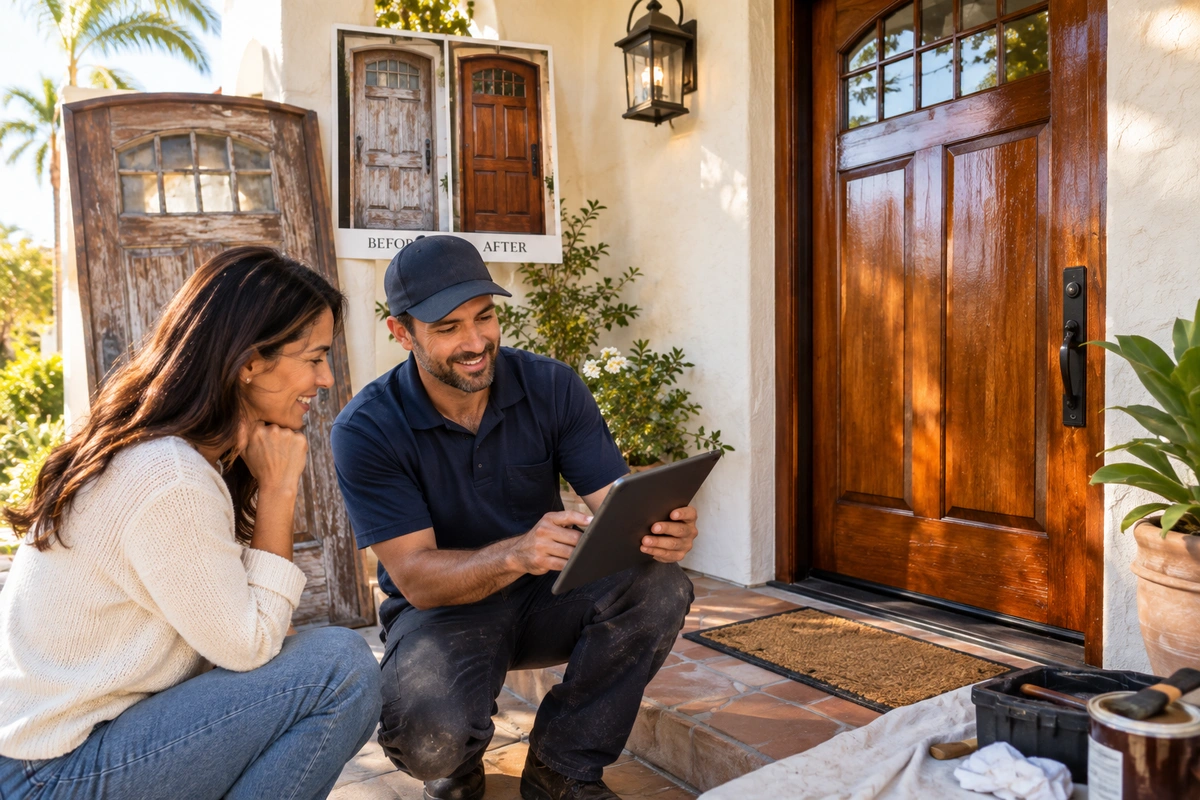
Get Your Free Los Angeles Door Refinishing Quote
Upload a photo and we’ll tell you honestly if now is a good window — or when to wait.
We respect your privacy. No spam, just a straightforward quote.
Frequently Asked Questions About Door Refinishing Timing in Los Angeles
These are the timing-specific questions we hear most often from Los Angeles homeowners once they’ve decided to move forward with a project — separate from the general cost and process questions covered on our main service page.
Can you refinish a door during LA’s rainy season?
We can, but we plan around it rather than through it. Winter refinishing projects are scheduled for a confirmed multi-day dry stretch, since both the stain and the sealing topcoat need time to cure fully before any rain contact.
Does the coastal marine layer in June affect refinishing timing?
Yes. “June Gloom” mornings along the coast push humidity above the ideal range for stain application, so coastal projects in that window are typically scheduled for the afternoon once the marine layer has burned off.
How far in advance should I schedule refinishing before Santa Ana wind season?
We recommend booking hillside, canyon, and coastal-facing exterior projects by early September if you want to complete the work before wind and fire-weather advisories start affecting scheduling flexibility in October and November.
Is a Los Angeles winter too cold to refinish a door?
Not usually. Daytime temperatures rarely drop below the low-50s even in December and January, which is within the workable range as long as it’s a dry day. Early-morning cold and overnight dew are the bigger factors we watch.
Do you refinish doors during a heat wave?
We adjust rather than cancel. During extreme heat we start earlier in the day, work in shaded intervals, and select products with slower flash times to prevent the stain from drying before it penetrates the wood.
Should I wait until after wildfire season to refinish my door?
Not necessarily — most of the year falls within some part of the extended Santa Ana/fire-weather window. We simply avoid scheduling exterior work during active red-flag wind advisories and proceed normally on calm days within that season.
Will refinishing now versus in six months change how long the finish lasts?
Less than most homeowners expect. The bigger factor in longevity is application quality and product choice, not the calendar month — a professionally applied marine-grade finish holds up similarly whether it was cured in April or October, as long as it was applied within the right temperature and humidity window for that day. Where timing matters more is on damaged doors: a door that’s already peeling or absorbing moisture will keep deteriorating while you wait, regardless of which season eventually rolls around.
Does my neighborhood’s microclimate matter more than the time of year?
For many properties, yes. A coastal home in the marine-layer belt and an inland Valley home a few miles away can be dealing with completely different conditions on the exact same day. That’s why we evaluate the property’s specific exposure — not just the month on the calendar — before recommending a schedule.